Oct 22, 2026Buying Guides
How to Measure Center-to-Center for Cabinet Pulls
Learn how to measure center-to-center hole spacing for cabinet pulls on existing and new cabinets, avoid sizing mistakes, and match standard hardware spans.
Replacing cabinet hardware is an effective way to update a kitchen, bathroom, or built-in storage run. A new set of handles transforms cabinetry, introduces fresh metallic tones, and improves everyday grip. Yet hardware updates often stall when a new handle fails to align with the holes in the cabinet front.
Cabinet pulls require precise alignment between two pre-drilled holes. If the distance between those holes differs even slightly, the screws will bind or sit crooked. Measuring your existing setup before ordering prevents costly delays and returns.
Few home projects are more frustrating than unboxing new cabinet pulls only to discover the mounting posts do not line up with the existing holes in your drawer fronts.
This guide explains how to measure center-to-center hole spacing on installed hardware and bare cabinet fronts. You will learn to distinguish hole spacing from overall length, navigate standard millimeter sizing rows, and select the right pulls for your project.
What Center-to-Center Means and Why It Differs from Overall Length
In cabinet hardware terminology, center-to-center (often noted as C.C or CTC) refers to the distance from the center of one mounting hole to the center of the other mounting hole. This represents the physical spacing between the two fasteners securing the pull to the cabinet front.
A common mistake is confusing center-to-center spacing with overall pull length. Overall length measures the handle from end to end. A pull might feature decorative extensions, overhanging bar ends, or stepped feet that extend beyond the mounting posts. A handle with 128 mm center-to-center hole spacing, for example, will have an overall length that extends past that span.
When shopping for replacement hardware for pre-drilled cabinetry, center-to-center is the sole dimension that determines whether the piece will fit into your existing holes. Overall length determines the visual footprint, but hole spacing governs physical installation.
How to Measure Spacing on an Installed Cabinet Pull
If your cabinets already have two-hole pulls installed, you can determine their center-to-center dimension without complex tools. A standard ruler or tape measure marked in millimeters provides an accurate reading.
The fastest method is to measure from the back of the cabinet front. Open the cabinet door or drawer box to reveal the interior surface. Locate the two screw heads holding the pull. Place the zero mark of your ruler over the center of the first fastener and measure straight to the second. Because fasteners are exposed inside the front, reading the midpoint between them is straightforward.
Alternatively, remove one pull to measure directly. Loosen the two rear screws and place the handle on a work surface. Measure the distance between the center points of the two threaded posts on the base, or between the center points of the two exposed holes on the front. If hole centers are hard to pinpoint, measure from the left edge of the first hole to the left edge of the second hole. That span equals the exact center-to-center distance.
Standard Spacing Dimensions Across the Catalog
Cabinet pulls are manufactured in standardized millimeter intervals. Understanding these standard spans makes it straightforward to match existing cabinetry or plan a balanced hardware layout across a room.
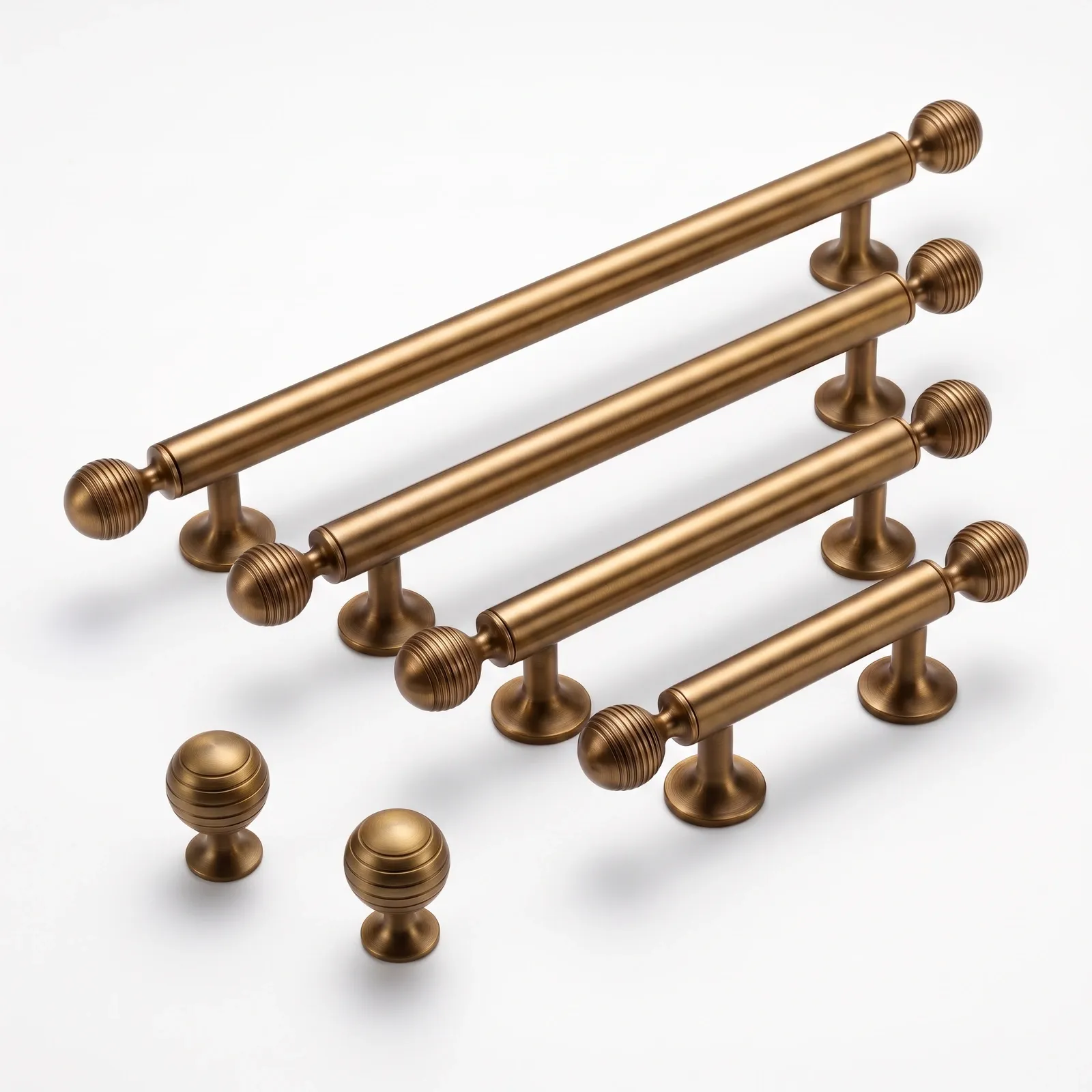
Across the live catalog, published spacing rows for standard cabinet pulls span from 64 mm up to 320 mm. The most frequently listed center-to-center spacings are 96 mm, 128 mm, and 160 mm. The 192 mm span is also widely listed. For compact installations, such as small edge pulls and compact bar pulls, a short spacing of 64 mm is common. Many pull designs provide extended multi-size rows covering 96 mm, 128 mm, 160 mm, 192 mm, 224 mm, 256 mm, 288 mm, and 320 mm.
Specialized cabinetry accommodates extended hardware formats. Appliance pulls designed for paneled refrigerators feature a 457 mm center-to-center span. Long profile pulls reach up to 480 mm, while wardrobe profile pulls span up to 780 mm. Select products also offer customizable sizing on request when unique dimensions are needed.
Measuring and Planning Spacing for New Cabinet Fronts
When fitting hardware onto new, un-drilled cabinet doors and drawer fronts, you are not restricted by pre-existing holes. Selecting your center-to-center spacing is an open design choice that defines the visual footprint and leverage of each handle.
The size of the front and the functional demand of the opening should guide your hardware selection. Small drawers, upper cupboard doors, and compact cabinets commonly take a single knob or a compact pull with 96 mm or 128 mm spacing. Wide drawers and heavier front panels operate most smoothly with a two-point pull spanning 192 mm, 256 mm, or 320 mm. Tall doors can take longer profile pulls that double as an architectural handle line.
Because individual pull profiles are frequently offered in several standard spans, you can step up the hardware size from top to bottom across a drawer bank. A shallow top drawer might use a 96 mm or 128 mm pull, while deeper lower drawers use 192 mm or 256 mm pulls from the same design family. This creates visual balance while ensuring that every drawer receives appropriate grip.
What to Check Before Ordering Replacement Pulls
Before purchasing replacement hardware, conducting a brief survey of your cabinetry prevents installation issues. Three essential factors require verification.
First, verify the mounting hole count on each front. Knobs are single-point mounted pieces that use a single hole, meaning they have no center-to-center dimension. Pulls are two-point mounted pieces, including bar, T-bar, edge, bridge, and appliance styles, which require two separate holes. Checking the hole count first ensures you know whether you are matching existing holes or planning to drill new ones.
Second, confirm that the center-to-center measurement of the replacement pull matches your measured hole spacing. Third, check the overall length of the pull against the width of the drawer front or door frame stile. Ensure that the handle ends leave adequate clearance so the hardware does not interfere with neighboring doors, drawer boxes, or adjacent walls.
How to Handle Unusual or Non-Standard Hole Spacings
Older cabinetry or custom woodwork may occasionally feature an unusual hole spacing that does not match common modern increments. When faced with an uncommon span, you have two practical paths forward.
The first option is to choose another piece from the catalog that offers your exact matching spacing. The product range repeats common center-to-center spacings across many different handle profiles, from classic bridge styles to modern bar and edge designs. This repetition makes a direct swap possible for most standard and compact dimensions without modifying your cabinetry.
The second option is to treat hole relocation as a finishing decision. You can fill the existing screw holes with wood filler, sand the repair smooth, and touch up the finish. Once prepared, you can drill fresh holes at a standard center-to-center spacing, such as 96 mm, 128 mm, or 160 mm. This approach allows you to install any pull style you prefer. Both approaches are practical, depending on your project goals.
A Quick Pre-Purchase Measurement Checklist
Before you place an order for cabinet pulls, run through this concise checklist to ensure a seamless installation:
Confirm the mounting hole count for each front, identifying whether you need single-hole knobs or two-hole pulls. Measure the center-to-center distance between fastener centers in millimeters, either from inside the front or by removing one pull. Verify that your measured spacing matches one of the published center-to-center rows for your selected pull. Compare total pull length against the width of the front to ensure balanced proportions. Note any large-format installations, such as 457 mm appliance pulls or profile pulls up to 780 mm for wardrobes.
With accurate center-to-center measurements recorded for every door and drawer front, selecting hardware becomes simple and predictable. When you are ready to update your cabinetry, browse the cabinet pulls range to find the exact hole spacings and handle designs that fit your space.