Edge and Hidden Pulls for Slab-Front Cabinets: Recessed, Finger and Side-Mount
Compare recessed, L-profile, back-mount, and side-mounted pulls for slab-front cabinets. Learn how door thickness, reveals, and mounting positions determine the right edge hardware.
Slab-front cabinetry highlights flat planes, continuous wood grain, and clean architectural lines. In modern kitchens, wardrobes, and bathroom cabinetry, standard bar pulls and projecting knobs can disrupt that quiet surface. Protruding hardware can also catch clothing in tight passages. Choosing edge-mounted and recessed hardware preserves the door face while providing a comfortable grip for daily use.
The catalog groups 11 products across 4 mounting situations: recessed into the face, clamped over the door edge, screwed behind the panel, or anchored to the reveal wall. Selecting the right pull begins with your door geometry rather than surface styling alone. Cutout requirements, cabinet reveal gaps, and door thicknesses dictate which mounting style best fits your casework.
Face Recessing: Cutout Slots and Flush Escutcheon Plates
Recessed hardware sits flush inside the door panel, making it suitable for sliding doors, wardrobes, and cupboards where protruding handles would hit the frame. The Recessed Sliding Door Pull with Textured Slot, set into a routed slot in the door edge, is a brass rectangular plate measuring 185 mm edge to edge and 150 mm hole to hole, with a width of 43 mm. An oval recessed finger slot with a textured slot floor provides a secure grip, with a slot depth of 10 mm that allows comfortable finger clearance without a deep cutout.
This brass pull accommodates door panels from 25 to 58 mm thick. Installers adjust for door thickness simply by trimming the screws supplied with the pull. On fronts where a flush face matters, the Recessed Flip-Up Cabinet Pull provides an alternative. Its zinc alloy rectangular escutcheon plate mounts flush in the door face, containing a finger tab that flips up to grip and lies closed when released. A rear mounting plate with 2 screw holes fastens the unit from behind.
Door-Edge Clamping: L-Sections and Rolled Profiles
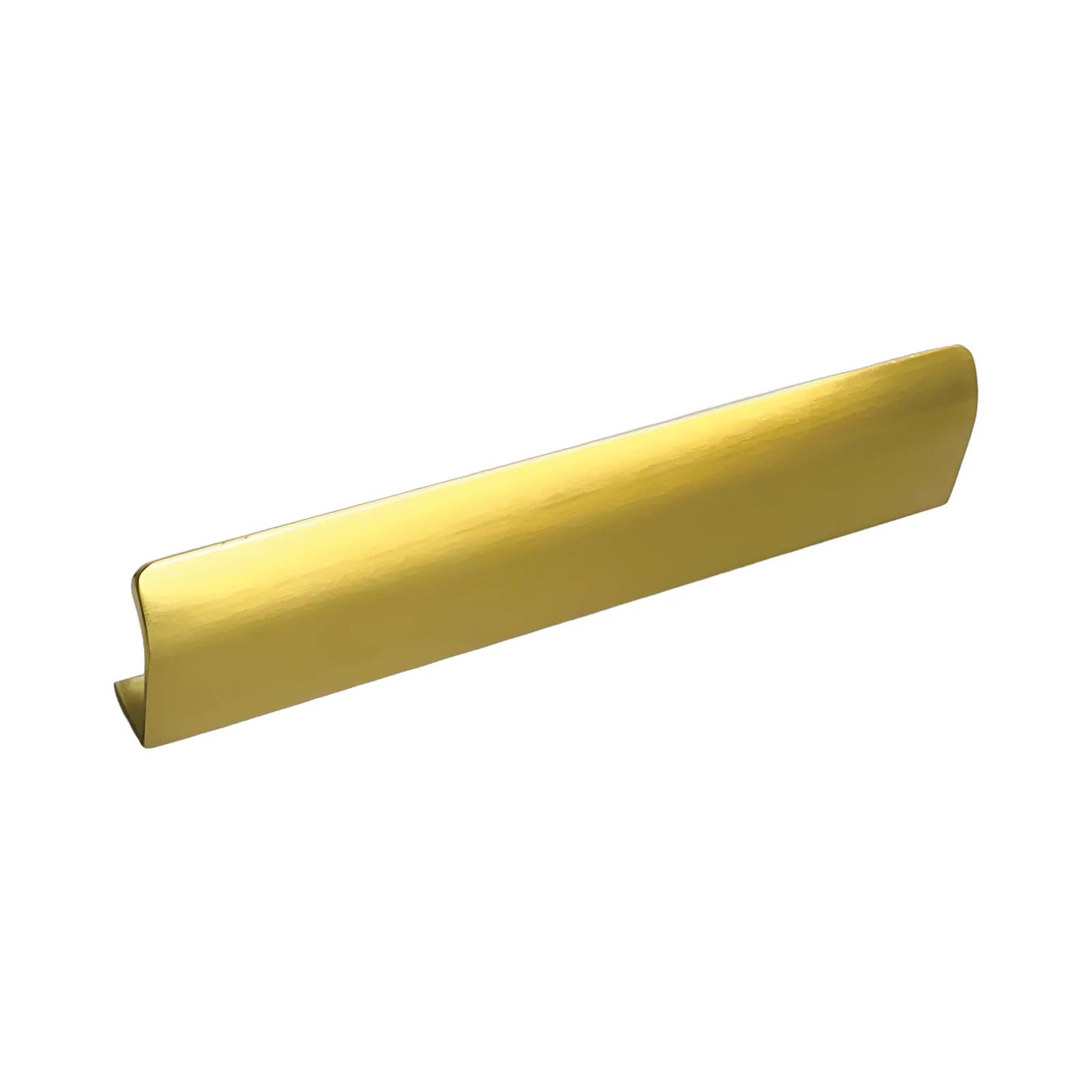
When routing pockets into the front face is undesirable, clamping an extruded pull over the door edge maintains an unbroken panel surface. The Recessed L-Profile Aluminum Edge Pull hooks over the door edge of a drawer or cupboard front. Featuring a sharp fold and return lip, it secures through 2 through-holes on the inner leg. Its profile height of 18 mm creates an understated reveal between drawer fronts. This profile is made to order in custom lengths, offered in Matt Black, Chrome, White, and Brushed Nickel.
Other edge-clamped variations provide rounded contours. The Rolled-Edge Aluminum Alloy Cabinet Pull features a rolled top edge, a section depth of 40 mm, and a section height of 20 mm, securing through rear countersunk holes. The Smooth-Arc Rounded-Nose Aluminum Cabinet Edge Pull uses a rounded nose, measuring 42 mm in section depth and 18 mm in section height. Both profiles come in custom lengths, with the rolled-edge model available in 10 finishes.
Rear Channel Fastening: Back-Mounted Lip Pulls for Overlay Panels
Needing no routing or face cutouts, the Back-Mount Aluminum Finger Edge Pull is an aluminum channel that fastens directly to the rear of the door leaf, leaving only a curled top lip visible at the door edge. This profile requires overlay construction or an open cabinet reveal so fingers can grasp the lip. Because the face of the door remains untouched, natural wood grain runs uninterrupted across adjacent cabinets.
Unlike custom-length extrusions, this back-mount design comes in 4 stock lengths with screws supplied. Center-to-center hole drillings are spaced at 64, 96, 128, and 160 mm, with overall lengths of 100, 132, 164, and 200 mm. In each size, overall length equals the center-to-center spacing plus 40 mm. With a profile height of 18 mm and 7 finish choices, this channel format creates a subtle shadow accent along drawer edges. If you are matching an existing pre-drilled front, the measuring method behind those numbers is laid out in our cabinet-pull measuring guide.
Side-Flange Anchoring: Pulls Set into the Reveal Wall
Certain cabinetry layouts require hardware that attaches neither to the front panel nor over the leading edge. The Side-Mounted Aluminum Edge Pull features an L-shaped extruded section with hollow rectangular ends designed for reveal cavities. Rather than fastening to the door panel, it secures through 2 countersunk holes on a rear flange to the side wall of the cabinet reveal for a concealed mounting method.
Anchoring into the reveal wall keeps the door leaf entirely free of fasteners, grooves, or metal lips. Because reveal widths differ between custom projects, the side-mounted pull is made to order in custom lengths and heights on request. Offered in six finishes, including Matt Black and Brush Brass, it suits wardrobe and cupboard interiors.
Geometric Accent Shapes: Half-Moon and Mirrored Arc Profiles
Edge-mounted hardware also includes distinctive geometric profiles that add character to slab fronts. A curved scoop that mounts along door edges, the Half-Moon Aluminum Edge Pull measures 80 mm in length, 40 mm in width, and 20 mm in height, with a center-to-center hole spacing of 64 mm. Its dimensions can also be customized to suit specific drawer banks, giving a finger grip without full-face hardware.
For double doors, the Mirrored Half-Round Zinc Alloy Edge Pull is sold as a mirror pair, forming a unified circular motif across meeting stiles. Offered in 2 sizes, both share a center-to-center spacing of 64 mm. The large size measures 96 by 57 by 12 mm with a foot of 16 mm; the small size measures 80 by 36 by 20 mm with a foot of 8 mm. When installed on paired doors, these mirrored shapes create a balanced focal point.
Section Heights and Face Clearances Across Cabinet Runs
Choosing among edge-mounted profiles also means comparing section height, which determines how far the form stands proud of the front. The large half-round pull stands only 12 mm proud — the slim option for a mirror pair meeting at double doors. The L-profile, back-mount channel, and smooth-arc design feature an 18 mm section height, providing balanced finger clearance. The rolled-edge extrusion and the half-moon pull sit at a 20 mm section height, offering deeper finger purchase.
While back-mount pulls use stock lengths, most edge-clamped and reveal-mounted designs are made to order in custom lengths. This custom sizing allows the extrusion to run the full width of a wide drawer front or align with adjacent cabinet margins. Extended profiles in this edge family also run to 1000 mm and 1200 mm, giving tall wardrobe fronts a full-height grasp without piercing the face.
Coordinating Finishes Across the Four Mounting Situations
Carrying a consistent finish across different mounting styles ties mixed cabinetry into a coherent scheme. Matt Black is offered in all 4 mounting situations, making it a dependable choice when combining recessed plates, clamped drawer profiles, and back-mounted channels. Chrome recurs across the edge-clamped and back-mounted families, and a Brass Gold or Brush Brass variant appears in each of the four situations.
A slab front offers no place to hide a grip, so the first decision is where the pull lives — routed into the face, clamped over the edge, screwed on behind, or set into the reveal. Each choice shapes both the shadow lines and the daily touch of the cabinetry.
Before ordering, verify reveal gaps and panel thicknesses on your drawings, check that drawer stacks leave space for top-mounted lips, and confirm sliding doors clear adjacent casing. Matching edge hardware to door geometry keeps clean elevations and a comfortable everyday grip — the edge pull range in the catalog gathers the profiles, lengths, and finishes for that job.